Translate

Monday, 9 March 2020

Trains & Guitars

We've done a fair bit of work on the Barn Station since I last posted. We decided that the sidings took way to much space up in the main layout, so we extended into the other half of the mezzanine. It's taken longer than expected, but we are now up and running again.

Also started on the scenery, I estimate another ten years should see it put to bed...

Here's a video catch up. Best watched with the amp turned up to full deci-deafening-bels....


Friday, 7 February 2020

Avian Update

Another year older, and finally I get my hearts desire. A new cock...
and what a big perky innuendo he is too...

The times they are a'changin'. This year someone forgot Winter. The Pyrenean slopes are devoid of the white stuff, with afternoon temperatures soaring to the 20's. We may be doomed, but so far it's quite a gentle doom down in the South of France.

Say one thing for climate change.
Say that my birthday, once in midwinter, is now well into spring!

And nowhere is that more clear than with my hoard of birds. Sorry. Flock to you...
My peacock (yet more possible play-on-words available) is really getting in the mood. His display is nearly fully grown and bloody impressive to everyone.

Everyone, that is, except his missus.

It was always and will always be thus.
Last year's baby has grown to the same size as its mother and appears to be of the same ilk. However, in the animal world, looks can be deceiving. Transgender has nothing on peacocks. It'll be another 6 months before we see if she's male or female. Or hairdresser.
The other newby birds, the Crowned Cranes, are developing a pink flush on their cheeks.
I'd feel pretty embarrassed too, living close to that vanity stricken peacock.

In other Early Spring Bird News, the lesbian swans started laying breakfast in mid January! I'm not sure what the lethal dose of omelette is, but my arteries live in fear now that the second of them has started laying too.
That rose bush also appears to be slightly concerned.

Birds, as I'm sure you are aware, are the only living dinosaurs. Thus, being short of non-avian dinosaurs, we've decided to plant one.

This weeping cedar will one day grow into one of those dinosaur shaped trees. Await the next photo in about twenty years time.
Planting for posterity.

I'll leave you with this picture of unrequited vanity.


Thursday, 16 January 2020

A Week in the Serengeti - Long Version

Tonight, instead of watching Coronation Street (I'm not sure of the French or American equivalents), instead of being depressed by the latest Trump Travesty, the latest Boris Buffoonery, the latest Macron Misstep, or even the Coming Climate Catastrophe, try watching this video instead!

It's a long one, nearly half an hour, but it will be half an hour of relaxation with a few thrills and spills, along with some suitable African music. All in less than 30 minutes.

It's a collection of my favourite photos from the seven days we spent in the Serengeti last year, compressed into a cornucopia of pleasures.

And a bit of gore.

Enjoy,


There's even a French version!

Cliquez ci-dessous pour la version française!

Profitez bien!


Wednesday, 8 January 2020

A Week in the Serengeti

I hope the festive season went well for you. The year has started a little rapidly with raging fires, the Mad God Trump attempting to start a world war, whilst Mad King Boris has done his usual disappearing act.

Depressing stuff. So I thought I'd cheer you up with a very few of my favourite pix from our week in the Serengeti, along with a bit of African music. It's only 3 minutes long so don't start yawning yet.


I'll post a (much) .longer version soon, but if you missed all the previous blogs, they start here...

Here's the music & pix:

Enjoy!

Monday, 23 December 2019

Sura ya Mwisho

The Final Chapter

What a week that was. We have seen more wildlife in a week than many see in their lives. We are privileged to have done so. I can only hope that this variety of wildlife will persist for our grandchildren, and theirs, to see and marvel at.

Despite having written seventeen chapters covering twenty-eight different species, there were many more than that we saw. It would be impossible, as well as interminably boring, to include everything here, but this final chapter is for those that got away.

The Bat-eared Fox.

It's a fox.

With bat's ears.
The warthog, now apparently renamed the Pumba.
The mongoose. Most of these run off before photos are possible, except of their backsides. These Pygmy mongooses however like to pose.
These Rock Hyrax appeared previously in this blog, being nearly munched by a baby leopard, and I promised them their own chapter. Sadly, they've been downgraded to a bit-part.
Anywhere there is a rock, there is a rock hyrax. They just seem to be hanging about everywhere.
They're something like a cross between a guinnea pig and a rat. They're almost cute, but not quite...
This whole time, in all these chapters, we've mentioned no primates other than humans. Actually, we've hardly mentioned insects and reptiles apart from in the into, but anyway, just to balance things, here are the only two primates found in the Serengeti:

The Vervet monkey, he of the blue balls that I refrained from photographing...
 And then, of course, there are those vicious, dangerous killers. Man. Oops, sorry, the gentle baboon.
 The little guys can be cute...
 except when they dangle their thingies...

So that's it. All done.

An amazing week full of amazing wildlife, plus some random bits of weather.

Thanks to Nomad for the accommodation and food, thanks to Dixon for helping teach me Swahili, and most of all, thanks Ian for guiding us through this cornucopia of life. (Hehe, he will be desperately looking that word up to see if it is a complement or not.)
Until the next time:
Cheers!
Maisha Marefu
(long life)

Sura ya Kimi na Saba - Wanyama Wakubwa wa Serengeti

Chapter Seventeen - Giant Beasts of the Serengeti

Size IS important. As species evolve, they often get bigger. Being big can give you a major advantage. Just ask any school kid. In nature it can be a major survival trait.

But it is a trait that does not always work.


We've already looked at the elephant. They would be doing pretty well thank you very much, if it weren't for us humans.

But there are other giants out there, and three of them live in the Serengeti.

We tend to forget the buffalo. They look like cattle and hang around grazing, minding their own business.

But this is one of the most dangerous animals in Africa.
These are one of the few animals that will attack safari trucks.
Although, when in herds, they are usually passive.
Their horns are used as weapons against lions, against each other,
and against us. About 200 people are gored and killed by these huge horns every year.
They have been called the "Black Death".
It's the old males that you need to be very careful of. The ones with broken horns, battered ears and swollen eyes. They tend to be on their own.
They tend to be grumpy old men...

But despite their strength, their power and their aggression, they often end up like this...


Another of the giants is the hippo. This is how they usually look when you see them on safari.
They are occasionally out of the water during the day, but they don't like the sun,
because they suffer sunburns.
This is thought to be the most dangerous animal in Africa. After humans and mosquitoes...
They kill about 3,000 people a year. (Mosquitoes kill about half a million.)
They soon get bored with all these statistics.
This is something of a rare sight. Hippos out of water in the shade of a tree.
All this brute force may make them seem unbeatable. But there is one animal that kills more hippos than any other.
Another hippo.

These injuries are as a result of a massive fight between two bull hippos.
And losing.

It has not got long to live...


The final giant is the rhino. Seeing these formidable creatures is becoming more and more difficult. There are very few left and they are heavily protected.

They are so few that each one is named. Say 'hi' to Julie.
We only saw her at a very long distance, and she immediately spotted us and ran off.
She was not happy, with good reason.
Her three month old daughter had recently been taken from her to help restock another area. This, understandably, appears to have driven her mad.
Our sighting was the last time she was seen.

Rhino's are having a tough time....


OK. That's enough sadness for now, only one chapter to go! Yay!

Sunday, 22 December 2019

Sura ya Kumi na Sita - Simba Watoto wa Serengeti

Chapter Sixteen - Lions Cubs of the Serengeti

It was early in the week, with the sun still shinning, that we came across this pride of lions sheltering from the sun under a tree. Here were two lionesses with their cubs.
All the cubs wanted to do was to play...
and cuddle.
The mother was more interested in cleaning them.

Doesn't this sound oh so familiar?
Most of the cubs played around the base of the tree, play fighting and play hunting,
and tried to make sense
 of a world gone mad,
One of them decided that he was the look-out.
checking for all possible threats.
They were safe. Most dangers had already passed. Few indeed would be rash enough to attack this pride.

When the cubs are younger however, there is a very real risk, especially from hyenas.  The cubs must be hidden.

Well hidden.

On our last day in the Serengeti we came across this female all on her own.

Or so we thought.
She was not alone.

She started to call. A lions call is loud, deep and guttural. You can feel it through your feet.
Was she calling her mate? Was she calling her siblings?

No.

She walked over to a crack in a nearby rock, and there appeared a little face responding to the call.
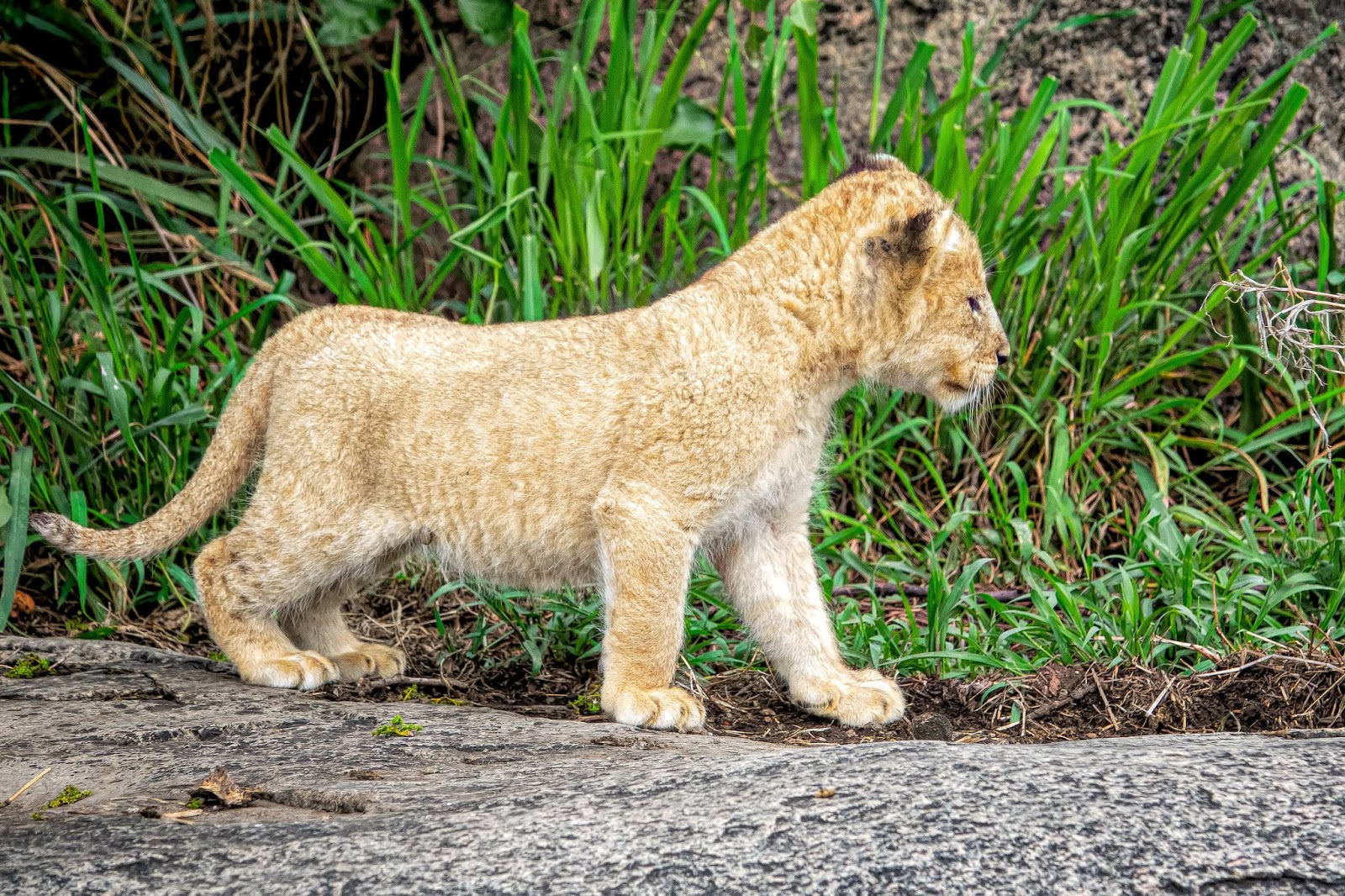
It was a tiny lion cub. Its eyes had recently opened for the first time. It was still learning how to walk.
And it was not on its own. A writhing pile of fluff appeared.
Four cubs, ready to discover this new world.

Ready to be cleaned
Ready to discover how to stay upright.
Ready for hugs.
Ready to discover how big mums feet are
Life.
Adventure
The hunt!
Erm, what am I supposed to do?
This way?
Or this?
over here?
but never far from the others
Time for one more adventure?
Nope
Time to be picked up
and put back into the den
Time for bed,

Last one home...

From these tiny balls of fluff, we go to the other extreme, in the penultimate chapter, get ready for buffalos, hippos, and even rhinos. Never a dull moment...